

Father Henry Leduc, a Catholic priest, was deeply concerned about Edmonton’s young girls not having access to religious education. A significant event took place on January 25, 1925, when three nuns arrived in Edmonton at the invitation of Archbishop Henry Leduc. The sisters were entrusted with the critical mission of organizing religious education for Catholic girls in remote areas.
For several months, Henry Leduc rented a house before purchasing a property located at 11837 Street in downtown Edmonton. Across the street was the St. Alphonsus Redemptorist Parish. More on edmontonka.com.
How It All Began
Upon their arrival in Edmonton, the sisters conducted a census in five city parishes and the town of Beverly, visiting over 5,000 homes. They organized catechism classes for girls, open not only to city residents but also to rural families and immigrants. The lessons were provided free of charge.
By the fall of the same year, the sisters were teaching children religion after school and had also opened an additional class for adult learners. To maintain contact with the children during the winter, they distributed printed religious lessons. This «postal» method of education began in January 1926, with the approval of Archbishop Henry Leduc.
This approach later proved to be effective in fostering faith among rural families in Western Canada. The nuns developed structured religious courses from grades 1 to 12. At its peak, the correspondence school enrolled over 2,000 students. These courses laid a strong foundation for specialized schools. Throughout the year, primarily on weekends, the sisters continued teaching lessons in Edmonton.
Shortly after the correspondence school was established, the sisters began traveling to various rural settlements during the summer months. They conducted catechism classes and prepared students for sacraments. This method of teaching continued until 1966.
Transition and Evolution of the School
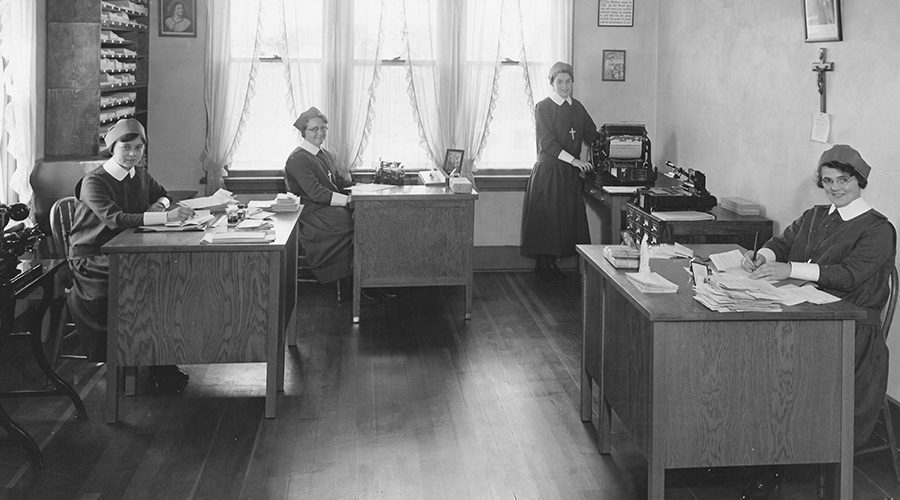
In 1967, the correspondence school’s office was relocated to 11353 Jasper Avenue. At that time, changes in teaching methods and a shortage of staff necessitated adjustments. In 1968, the sisters began serving in apostolic roles throughout the city. One prominent example was Sister Rita Patenaude, who served as the chaplain for the Newman Centre at St. Joseph’s College and later became the first woman national chaplain.
In 1971, a pivotal decision was made to merge the correspondence school with Regina Religious School, transferring all students to the new institution.
Over the years, the sisters also served in the Catholic Migration Service and Alberta Social Service. Sister Mary Jackson continued catechetical work as the director of religious education for Edmonton Catholic Schools.
Sister Frances Coffey became part of a team offering home and parish retreats, prayer leadership, and spiritual guidance in South Edmonton.
The Women’s Dormitory
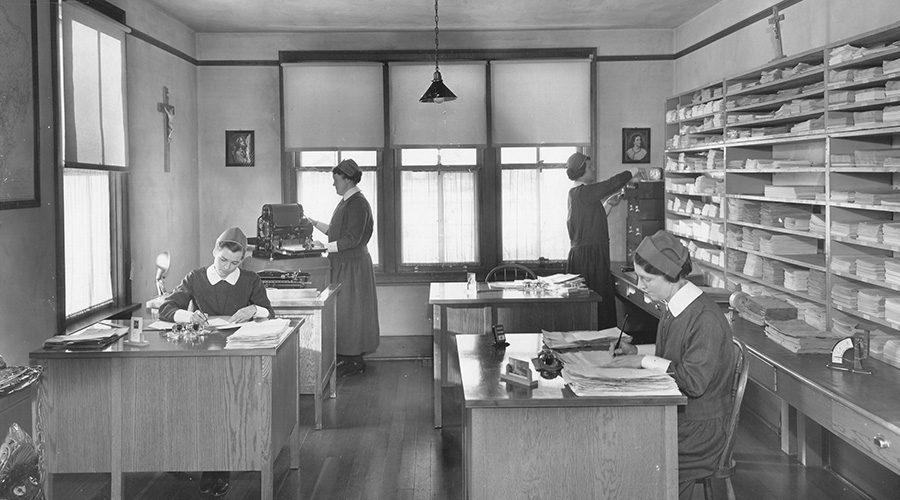
In 1971, a Catholic dormitory, later known as a residential club for women teaching in Catholic schools, was established at 9919 105th Street. Over the next 38 years, this facility became home to hundreds of young women.
The first residents included young women from Europe, the British Isles, and Alberta farms. The dormitory provided accommodation and meals for women who were studying or finding suitable employment. In its later years, the residence housed up to 30 women aged 17 to 25, offering them a supportive environment to transition to independent living while practicing their Catholic faith.
For many years, nuns lived in the residence alongside teachers, nurses, and social workers. The residence was only closed when it was decided to undergo renovations.