

Café · Edmonton · ⭐ 9.3/10 · 769 reviews · updated: 2026-08-10 17:37:16
Address: 12021 102 Ave NW #103, Edmonton, AB T5K 0R8, Canada
Most cafés begin with a room and add the coffee afterwards. Iconoclast Coffee Roasters did it the other way round. The first business plan its owner wrote, back in 2007, was for a roastery and nothing else — no counter, no seats, no kitchen. Roasting started two years later out of a rented warehouse, and only afterwards did a café attach itself to the drum. Nearly everything you notice in the room today follows from that order of events: the coffee is the parent business, and the café is simply where it gets poured.
Highlights
- A working roastery, not a café that buys in. Beans are roasted on the premises in small batches on a fifteen-kilogram drum, several days a week — what you smell in the room is that day’s production rather than a scent diffuser.
- A heritage warehouse conversion. The flagship has occupied the Oliver Exchange building since 2019, a brick industrial block west of the downtown core reworked into a hive of small independent tenants.
- Living wages and no paid advertising — stated flatly by the business as policy, not as a campaign. It is an unusual pair of commitments to print on a coffee bag, and it shapes how the place is run.
- Compostable packaging only. Retail bags and takeaway service are built around that constraint instead of treating it as an optional extra.
- A full kitchen behind the counter, which puts this well past the muffin-and-a-flat-white model most roastery cafés settle for.
- A second, smaller room in LeMarchand Mansion, one of Edmonton’s best-known heritage apartment buildings, for anyone who wants the same coffee in a quieter setting.
What’s in the cup
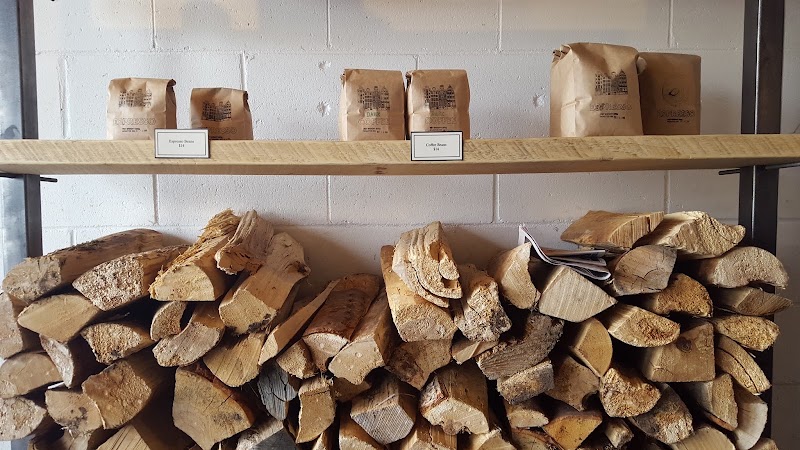
This is a single-origin house rather than a blend house. The retail shelf tends to carry a small rotating set — an Ethiopian Yirgacheffe and a Colombian Huila have both been fixtures — and the roasting philosophy is stated in plain terms: daily, in small batches, on one machine. That machine is a fifteen-kilogram Has Garanti drum, a size that matters more than it sounds. Fifteen kilos is a roast you can still steer by hand and by ear; it forces the operation to work in short runs, and it means the coffee behind the counter has rarely been sitting anywhere for long. Output runs to a few hundred pounds a week across roughly four roasting days, which is a genuinely small-batch rhythm for a business that also supplies bags and wholesale.
Because there is a drum on site, the espresso and the filter are not the same decision made twice. Roasting your own means the profile can be pulled in whichever direction the room needs — and in a café attached to a roastery, the room usually needs an espresso that survives milk without going flat, plus a lighter, brighter option for anyone drinking their coffee black. Ask which single origin is on at the moment and whether it is better through the machine or through a filter; the staff here answer that question for a living, and the answer changes as lots come and go.
Tea is not treated as an afterthought either — the loose-leaf side comes from a local blender rather than a catering supplier, which is a small tell about how the business thinks. If you are the person who always ends up ordering something without caffeine, you are less likely to be stranded here than in most roastery cafés.
Who’s behind it
Iconoclast belongs to Ryan Arcand, who has been part of Edmonton’s coffee trade for the better part of two decades. He wrote his first plan in 2007, started roasting in 2009 from a warehouse on the north side, and ran an earlier café under the Koffiehuis name until that lease ran out in the summer of 2018. The move into the Oliver Exchange building the following year was a step up in scale: a full kitchen, a proper roasting floor, and a room big enough to behave like a public space rather than a takeaway hatch.
Arcand talks about cafés in civic terms rather than commercial ones — as places that give people daily access to somewhere that is neither work nor home, and as the reason a building full of small tenants feels alive rather than merely occupied. That is not a slogan invented for the website; he has been saying versions of it in local press for years, and it lines up with what he has actually built. Since 2025 he has added a restaurant in a reclaimed electrical substation nearby and a cheese shop run with one of the city’s better-known chefs, with a basement growing room supplying microgreens to the group. Whatever else you think of that, it is a coffee roaster deliberately turning one corner of a neighbourhood into a cluster instead of chasing a second location across town.
Who it suits
Working with a laptop. The room is large by Edmonton café standards — roughly sixty seats — and it sits in a building full of studios and small offices, which means daytime laptop use is normal rather than tolerated. Nobody here is going to hover over you. The honest caveat is the one that applies to every warehouse conversion: power outlets in old brick buildings are wherever the electricians could get to, not evenly spread along the walls, so if you need to plug in, scan the perimeter before you commit to a table. Arrive with a charged battery and you have no problem at all.
Meeting someone. This is the strongest use of the place. A big room with hard surfaces and a working roaster is never library-quiet, and that is exactly what makes a two-person conversation comfortable — there is enough ambient noise that you are not performing for the next table. With a full kitchen on site, a coffee meeting can turn into lunch without anyone having to relocate, which is why so much informal business in the area seems to get done here.
Taking it away. Straightforward, and the packaging question is already settled: compostable, by policy. If you are heading for the river valley, which begins a few minutes south, this is the logical last stop before the trail.
Sitting alone. Perfectly easy. The scale of the room means a solo table is not conspicuous, and the counter is the sort where asking a question about the coffee is welcome rather than an imposition.
The space
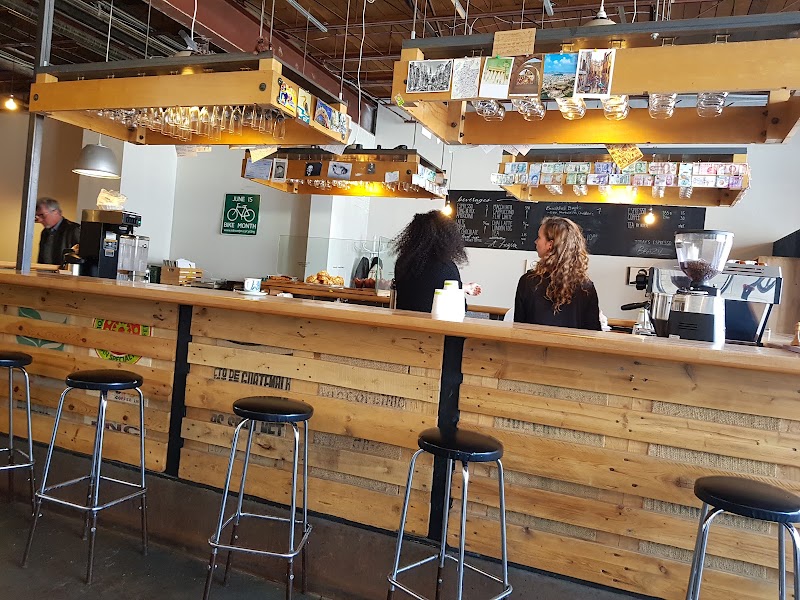
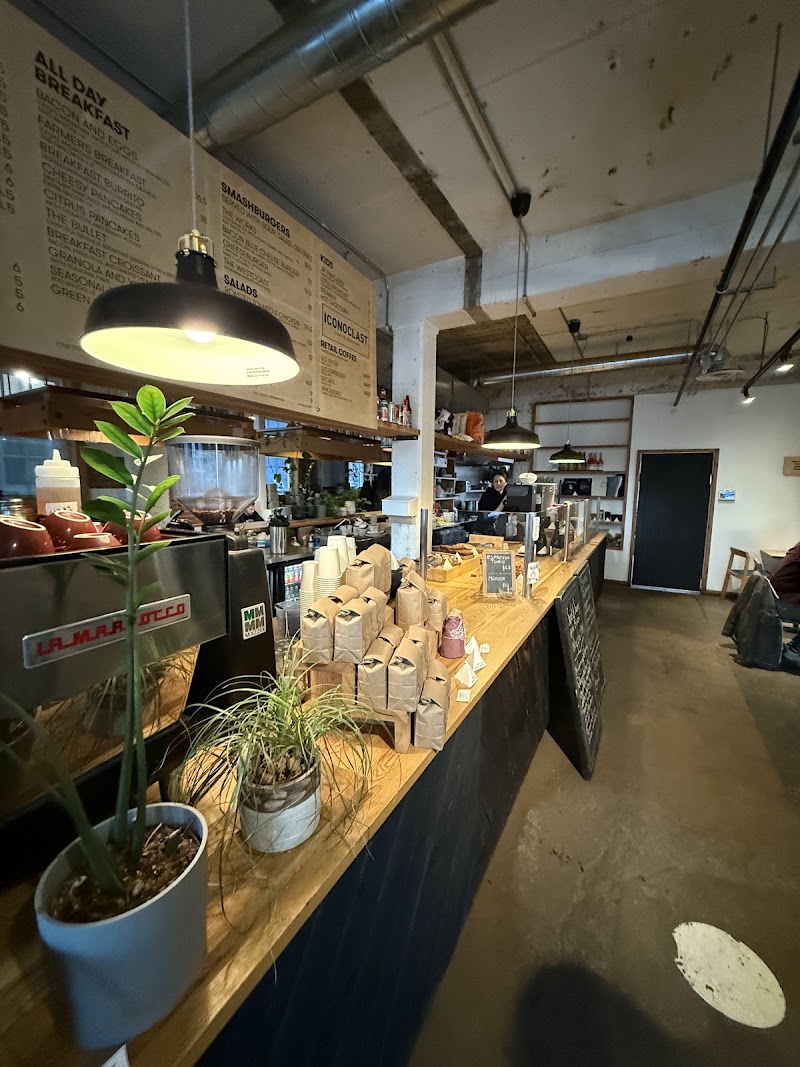
The building is the point. Oliver Exchange is a converted industrial block, and the café keeps the vocabulary of the original — brick, timber, tall windows, ductwork left visible overhead — without pretending to be a museum piece. The proportions are generous: high ceilings, long sightlines, room to walk between tables with a tray. Around sixty seats gives you a real choice of where to sit, from a table near the windows to something tucked away from the door, and in warm months a seasonal patio opens up outside.
The trade-off of a room like this is acoustic. Brick and hard floors bounce sound, the espresso machine and grinder are not quiet, and when the roaster is running there is a low mechanical presence in the background. Most people read that as atmosphere; if you need silence to think, bring headphones. The second Iconoclast room, in LeMarchand Mansion, is a different proposition entirely — smaller, softer, contained within a heritage apartment building — and it is the better bet on a day when you want the coffee without the volume.
Beyond the coffee
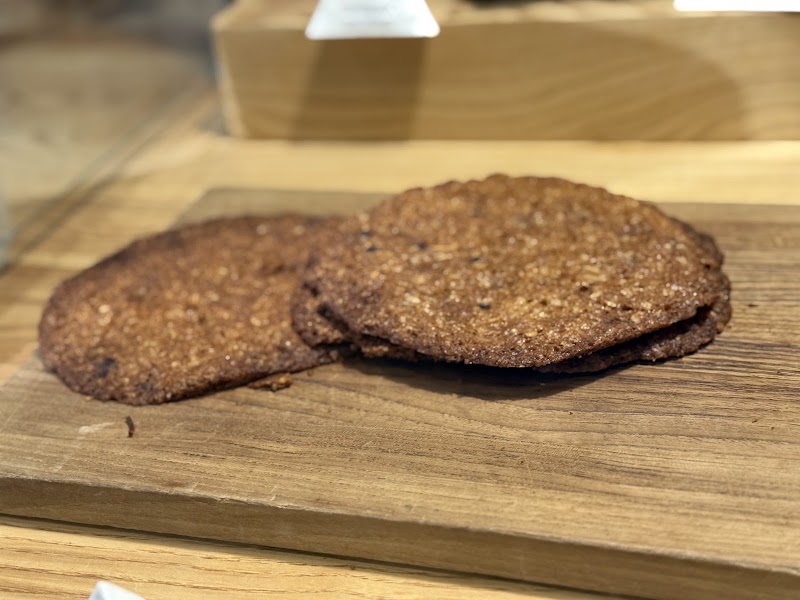
The presence of a full kitchen changes the calculation. Where most roastery cafés run a pastry case supplied by somebody else, here there is cooking on site, which means a visit can be an actual meal rather than a coffee with something sweet attached. Expect a kitchen-led approach — food built around vegetables, local suppliers and things made in-house rather than a laminated list of sandwiches. The wider group the café now sits in reinforces the point: a restaurant and a cheese shop within a short walk, run by the same owner, with produce coming partly from a growing room in the basement.
The practical upshot for a visitor is that you should check the counter before deciding what kind of stop this is. Come in expecting a quick espresso and you may find yourself staying for lunch; come hungry and you will not be sent elsewhere.
When to come
The room opens early enough to catch the commute and closes in the early evening, so this is a daytime café, not a night one — do not plan an after-dinner coffee here. Mid-morning on a weekday is the sweet spot for a quiet table: the first wave of takeaway orders has passed and the lunch run has not started. Weekday lunch is the busiest stretch, since the building and the surrounding blocks empty into the room. Weekends are steady but slower-paced, with more people settling in for an hour than passing through.
If the roaster is running while you are there, treat it as a bonus rather than a nuisance: it is not a daily event, and watching a drum work is one of the few genuinely interesting things a café can offer.
Getting there
The café sits in Wîhkwêntôwin — the dense, high-rise neighbourhood immediately west of downtown, renamed in 2024 from its former name of Oliver — in a converted warehouse block that is a landmark in its own right. From the western edge of downtown it is a comfortable walk; from the nearest LRT stop, at the eastern end of the neighbourhood, allow roughly a quarter of an hour on foot, or take one of the frequent buses running the corridor. Cycling is easy, as the neighbourhood connects directly to the river valley trail network just to the south. Drivers should expect street parking rather than a dedicated lot, which is normal for the area and rarely a serious problem outside the lunch peak.
Good to know
Two things will shape your visit more than anything on the menu. First, this is a roastery that runs a café, not a café with a decorative roaster — so buying beans to take home is not an afterthought here, and asking what came off the drum most recently is a reasonable question. Second, the ethical commitments are not decoration: compostable packaging means the takeaway experience is built around materials that break down, and the living-wage position means staffing costs are visibly part of how the business is structured and run.
Be aware that the same owner now runs several neighbouring businesses, so a recommendation to “go to Iconoclast” from an Edmontonian may be pointing you at a small cluster rather than one door. And be aware of the two-location question: the flagship and the LeMarchand Mansion room share a name and a coffee supply but not a character. Check which one you have been sent to.
Questions and answers
Do they roast their own coffee?
Yes — on site, in small batches, on a fifteen-kilogram drum. Roasting is the original business; the café came later.
Can I work here with a laptop?
Yes, and it is common. The room is large and sits in a building full of small tenants. The only caveat is that outlets in a converted warehouse are not evenly distributed — look before you settle in.
Is there real food, or just pastries?
There is a full kitchen on the premises, so this works as a lunch stop, not only a coffee stop.
How many Iconoclast locations are there?
Two: the flagship in the converted Oliver Exchange warehouse and a smaller room inside LeMarchand Mansion, a heritage apartment building nearby.
Who owns it?
Ryan Arcand, who wrote the original roastery plan in 2007 and has been roasting in Edmonton since 2009.
Is it noisy?
Moderately. Brick, hard floors, a busy espresso bar and sometimes a running roaster add up to a lively room rather than a quiet one. Good for talking, less good for deep concentration without headphones.
Can I buy beans to take home?
Yes, and it is arguably the main event. Bags are packed in compostable material, and the range leans towards single origins rather than a permanent house blend.
Is there outdoor seating?
A patio operates seasonally, which in this city means a fairly short but well-used window.
Is it easy to get to without a car?
Yes. It is walkable from downtown, close to frequent bus service, and directly connected to the river valley trails for anyone arriving on a bike.
Opening hours
| Day | Hours |
|---|---|
| Monday | 08:00–18:00 |
| Tuesday | 08:00–18:00 |
| Wednesday | 08:00–18:00 |
| Thursday | 08:00–18:00 |
| Friday | 08:00–18:00 |
| Saturday | 08:00–18:00 |
| Sunday | 08:00–18:00 |
Photos
Visitor reviews
Reviews last updated: 2026-08-10 17:37:16
Data is refreshed monthly. Sources: edmontonka.com and editorial picks based on reviews.
Дійсно гарна кав'ярня, щоб підбадьоритися вранці. Мені дуже сподобалися місця за барною стійкою. Смачна сирна булочка та непоганий лате.
Затишна атмосфера + справді смачна кава. Один з найкращих флет вайтів, які я куштував. Обов'язково повернуся.
Я вже деякий час ходжу сюди заради цього круасана на сніданок. Він щоразу ляскає. Тож, треба віддати належне. Яйце завжди приготоване ідеально, виходить блискучим і хитається, коли лежить на шматочку чудово приготованого…
Приміщення гарне та має чудову атмосферу. На жаль, обслуговування залишало бажати кращого. Я попросив кілька змін у своєму напої, але їх просто не зробили. Коли я ввічливо запитав про це після ковтка, відповідь була знев…
Заклад розташований у невеликій бізнес-будівлі. Сільська атмосфера створює зовсім іншу атмосферу. Затишне та спокійне місце, гарне місце для відпочинку після довгого робочого дня.
Меню просте та свіже, ціни досить станда…