

Emily Murphy was a remarkable woman from Edmonton. A talented writer, journalist, judge, politician, and reformer, she is remembered and celebrated by women worldwide. She became the first female magistrate in the British Empire. More on edmontonka.com.
Childhood
Emily was born on March 14, 1868, in Cookstown, Ontario. Her family was prominent, with her father, mother, and other relatives holding influential positions. Her maternal grandfather, a politician and newspaper owner, established the first Orange Order lodge in Canada. Emily grew up surrounded by influential individuals and was raised in an environment of privilege and ambition.
Education and Career
In 1887, Emily attended a prestigious private Anglican school for girls in Toronto. During her final year, she married Arthur Murphy.
In 1907, Emily and her husband moved to Edmonton. She began contributing regularly to prominent Canadian publications and received critical acclaim for her books and collections of short stories.
Emily seamlessly balanced her family life with her literary and reformist activities, advocating for the rights of women and children. She traveled extensively through Alberta’s rural areas. During one of these trips, she encountered a woman whose husband had abandoned her, sold their jointly built family business, and left her with nothing. Legally, the woman had no right to contest his actions.
This story deeply affected Emily, and she began her campaign to protect women’s property rights.
In 1915, the Alberta legislature, persuaded by Emily Murphy’s arguments, passed the Dower Act. This legislation granted women the right to contest the sale or lease of property without their consent. Emily’s efforts helped secure justice for the woman and paved the way for future reforms.
Emily went on to serve in leadership roles, including within the Canadian Women’s Press Club. That same year, she was awarded the Order of St. John of Jerusalem for her contributions.
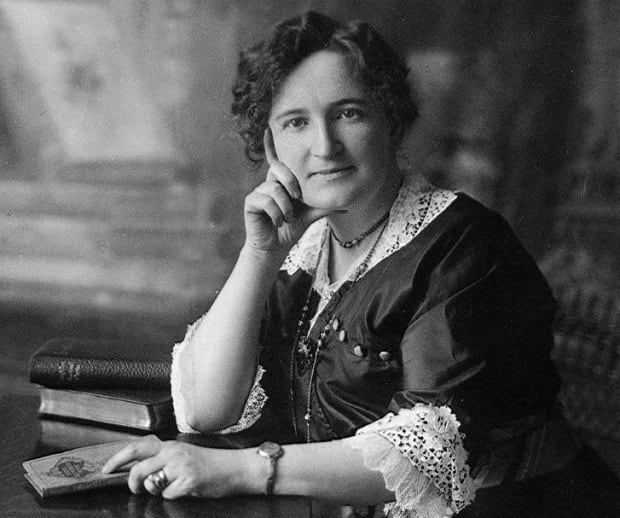
The First Female Judge in Canada
Emily’s career took an unexpected turn in 1916 when members of the Edmonton Local Council of Women were barred from attending a court case involving women accused of prostitution. Outraged, Emily protested to the provincial Attorney General.
Following this incident, she was appointed a police magistrate for the city of Edmonton and later for the province of Alberta. This appointment made her the first female magistrate in the British Empire. In this role, she became an advocate for women’s rights in the justice system and a leader in the fight against drug trafficking. On October 18, Emily ruled that women had the same rights as men under the Canadian Constitution.
While serving as a judge, Emily continued writing and publishing her works. One of her most notable contributions as a judge was her 1922 article “The Black Candle,” published in Maclean’s. The article detailed the dangers of drug trafficking and its harmful effects. Her remarks led local authorities to enact several laws regulating drug control.
Emily was a true suffragist. During her time as a judge, she faced significant opposition due to the Constitution’s failure to recognize women as “persons.” In response, she launched a ten-year campaign for women’s legal recognition.
In 1927, Emily invited several women seeking seats in the Canadian Senate to join her efforts. She prepared a petition to be submitted to the Supreme Court of Canada. In 1928, the Supreme Court rejected her petition. A year later, however, the Privy Council overturned the Supreme Court’s decision, concluding that women could be appointed to the Senate and enjoyed the same legal rights as men.
Later Years
Emily remained active in Canadian legislative reform, often experiencing stress and frustration over persistent injustices, which took a toll on her health. She developed diabetes as a result of prolonged stress. After battling the illness for three years, she passed away in 1933.